
World Storytelling Day was held in March. I’ll forgive you if it was overlooked. While it’s a global event that has grown from modest Swedish origins in the early 90s, it doesn’t carry the same awareness as other celebrations.
As the day approached this year, I realized that for all the time I spend talking about data storytelling in the context of data and business decisions, I’ve never actually stopped to define what “story” means.
I’ve unconsciously slipped into relying on an assumed understanding, and for an experience that is uniquely human, but doesn’t show up nearly enough in the way we work, it’s worth rectifying that.
World Storytelling Day felt like the right moment to make that happen.
Start with the word
We hear it constantly. That’s a great story. They’re a strong storyteller. Where’s the story in this data? It’s said so often, in so many contexts, it’s now shorthand for multiple meanings.
It’s why a leader can walk out of a presentation asking “but where’s the story?” while the presenter walks out wondering what more they could possibly have given. Same meeting. Different assumptions of the same word.
But assumptions aren’t definitions. And that gap is where a lot of data communication goes wrong.
Story is hard to define because it doesn’t live exclusively in structure. One person’s fantastic story may be a fantastic bore to another. Which tells us story lives in how it’s experienced – you recognise it by what it does to you.
So instead of defining what a story is, let me ask: what happens when you’re in the presence of one?
What story actually does
Take a moment to think about a great story you’ve experienced. I’d be willing to bet something struck you before you had a chance to prepare for it. Maybe it was a catch in your chest. A smile you discovered spreading across your face. Unease that settled in before you’ve consciously processed what’s happening.
You had a response before you decided to have one.
Understanding that reaction is where intentional storytelling begins.
In a story, you feel stakes – there’s an and then what? pulling you forward, something that matters enough to keep you from looking away. And you remember it differently – not necessarily the details, but what stayed with you, long after the specifics have blurred.
Its absence is just as familiar. The book you keep putting down, or the show where you don’t think twice about stepping away. The presentation with accurate, thorough data that just doesn’t land. Processed, but not felt. Seen, but not retained.
So what we’re really asking for when we say “give me the story” is the experience. The question is how you get there with intent. It’s a skill, not a talent, and it starts with the choices you make.
Story is in the choices
That experience can feel like a tall order in the data space. How easy is it, really, to make a campaign result of 4.2 into an emotional tether? Are we really trying to make next year’s fiscal plan into an Oppenheimer kind of compelling narrative?
No, we’re not. And not just because a fiscal plan that needs an Oppenheimer budget to “tell better stories” is sure to get rejected.
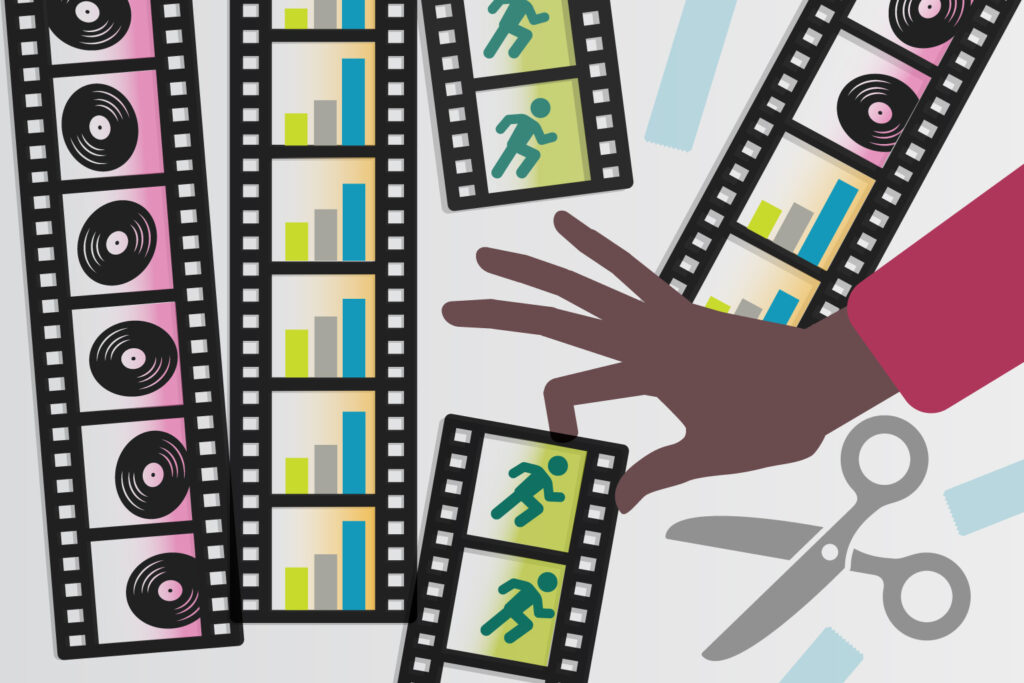
The filmmaking world, though, does have something directly useful to offer here.
Knowledge-led storytelling, which is really what data communication is, carries the same discipline as documentary filmmaking. Both are built on real material. Real events. Real evidence. The constraint they share is the same: neither can invent a better fact. They work with what actually happened, what the data actually shows, what is actually true.
In the hands of a skilled storyteller, documentaries have the power to create a moving experience – to bring an audience to a new understanding. But others, even on the same topic, gather digital dust.
The difference isn’t in the facts. It’s in what someone chose to do with them.
Great documentary filmmakers are obsessive students of their audience. They’re not making films for “everyone.” They’re making films for a specific person, and trusting that specificity creates universality. Every choice is anchored in a precise understanding of who is sitting in the audience, what they already believe, and what they need to feel differently about by the end.
The discipline of choice
A documentary filmmaker has hours of footage, hundreds of facts, dozens of interviews. Story happens in the choice of what to do with them – what to include, what to cut, whose face to show at which moment. The events are the material. The choices are the story.
If you’ve ever had to explain what data means to someone who needs to act on it, you’ve faced those same choices – even if the choice was to hand everything over and let the audience decide on the story.
The data is the material. What you do with it is the story.
When story meets the boardroom
A documentary can afford to let the audience find their own way forward. It takes them somewhere they weren’t, shifts something in how they see the world, and trusts them to decide what to do next.
A business data story can’t afford that. There is a specific decision to be made. A specific person who needs to make it. A specific ask, and a room full of people who showed up believing they were there for a reason.
All of which means the energy that typically goes into adjusting the deck – tightening the chart, changing the colour, getting the title right – is being spent on the wrong layer.
Those things matter at the margin. But they’re not what determines whether the story lands. What determines it is the depth of understanding of the person on the receiving end. What they’re accountable for. What they already believe. What would shift their thinking. What would make their eyes roll before you finish a sentence.
What anchors the experience
The choices that constitute a business story aren’t just editorial judgment. They’re anchored to that audience understanding, and that anchor separates curation from editing, structure from sequence.
Unanchored choices could still add up, but not to an intentional story that moves anyone anywhere specific.
What makes a story a story isn’t the material. It’s the depth of understanding of the person you’re making those choices for – and the clarity about where you need them to arrive.
That’s where it begins. Long before you open the deck.
If you’re on either side of this frustration – asking for better stories or trying to deliver them – and neither of you can quite close the gap, that’s the conversation worth having. Let’s talk.